
ERP system for manufacturing
We develop ERP systems for furniture, metalworking and food manufacturers. A customer order becomes a specification and a production order, materials are purchased to match the plan, the warehouse, shop floor and accounting team work in one system, and managers see the cost and margin of every order.
Based on last 100+ reviews


When does a manufacturer need an ERP system?
How does an order move through production?
-
OrderThe sales manager prepares a quote, the system compiles the specification and price, and the customer confirms.WhoSales repThe delivery date reflects the shop floor workload.
-
Planning and materialsThe order is scheduled across work areas, and the system calculates material requirements and prepares purchase orders.WhoProcurementPurchasing two weeks before work starts.
-
ManufacturingThe warehouse issues materials against the order, and work areas record completed operations.WhoWarehouse and shop floorEvery sheet is charged to its order.
-
Dispatch and invoicingThe completed order is delivered and installed, the invoice goes to the customer, and managers see the margin.WhoLogistics and accountingThe acceptance form is signed on a phone.
What modules does a manufacturing ERP system include?
Sales, inventory, purchasing, customers and invoicing come from the ERP system. For make-to-order manufacturing, these modules are added.
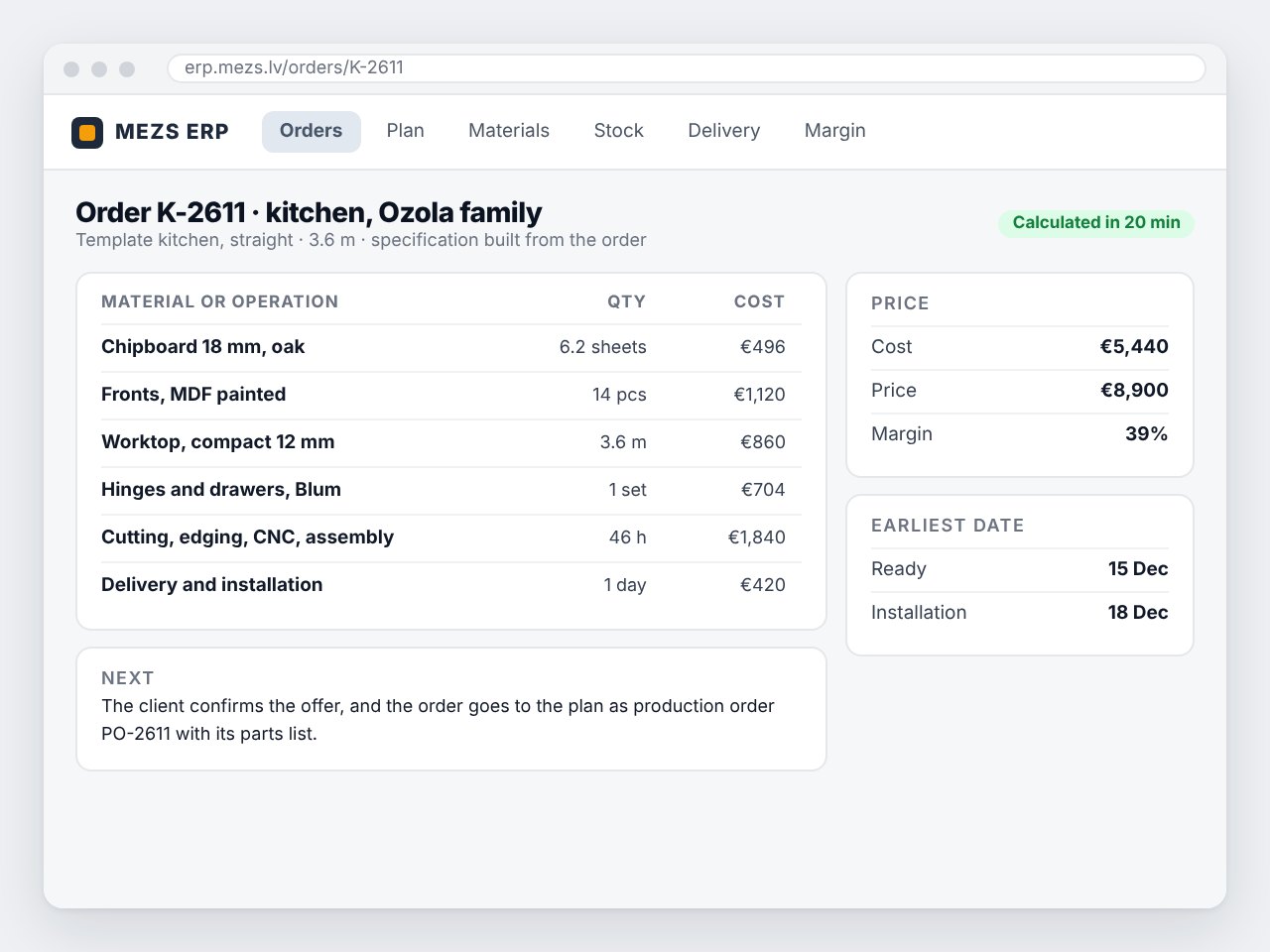
Orders and specifications
The sales manager creates an order, and the system uses a product template to compile the specification: materials, parts, operations and the customer price.
Example: Quoting a kitchen to the customer's dimensions takes 20 minutes instead of two days of correspondence with the designer.
Manual calculations.
Specification from the order.
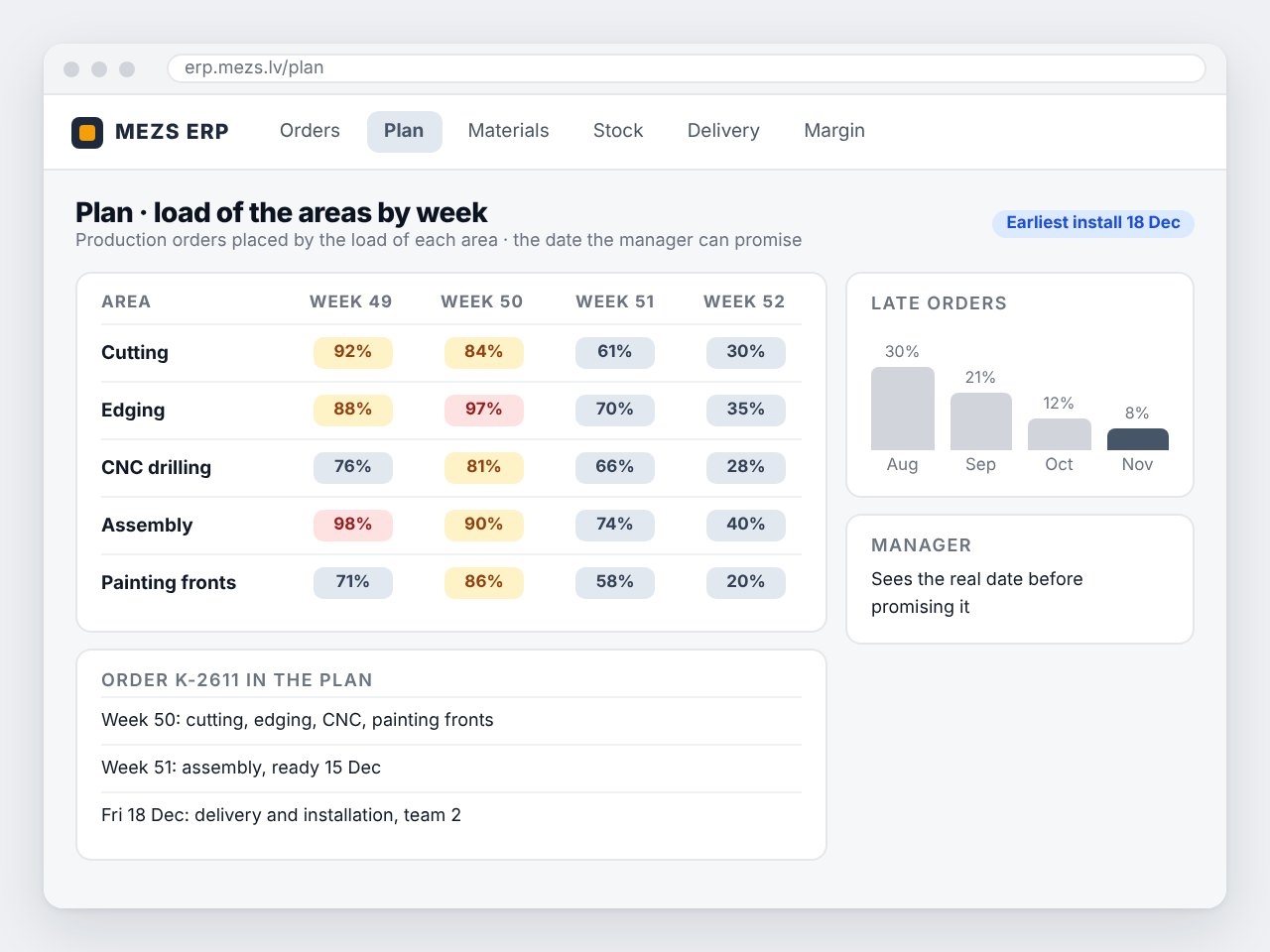
Planning and deadlines
Production orders are scheduled based on each work area's workload, so the sales manager sees a realistic delivery date before promising it to the customer.
Example: Customer delivery dates match the shop floor plan, and late orders have fallen from 30% to 8%.
Delivery dates by guesswork.
Delivery dates based on workload.
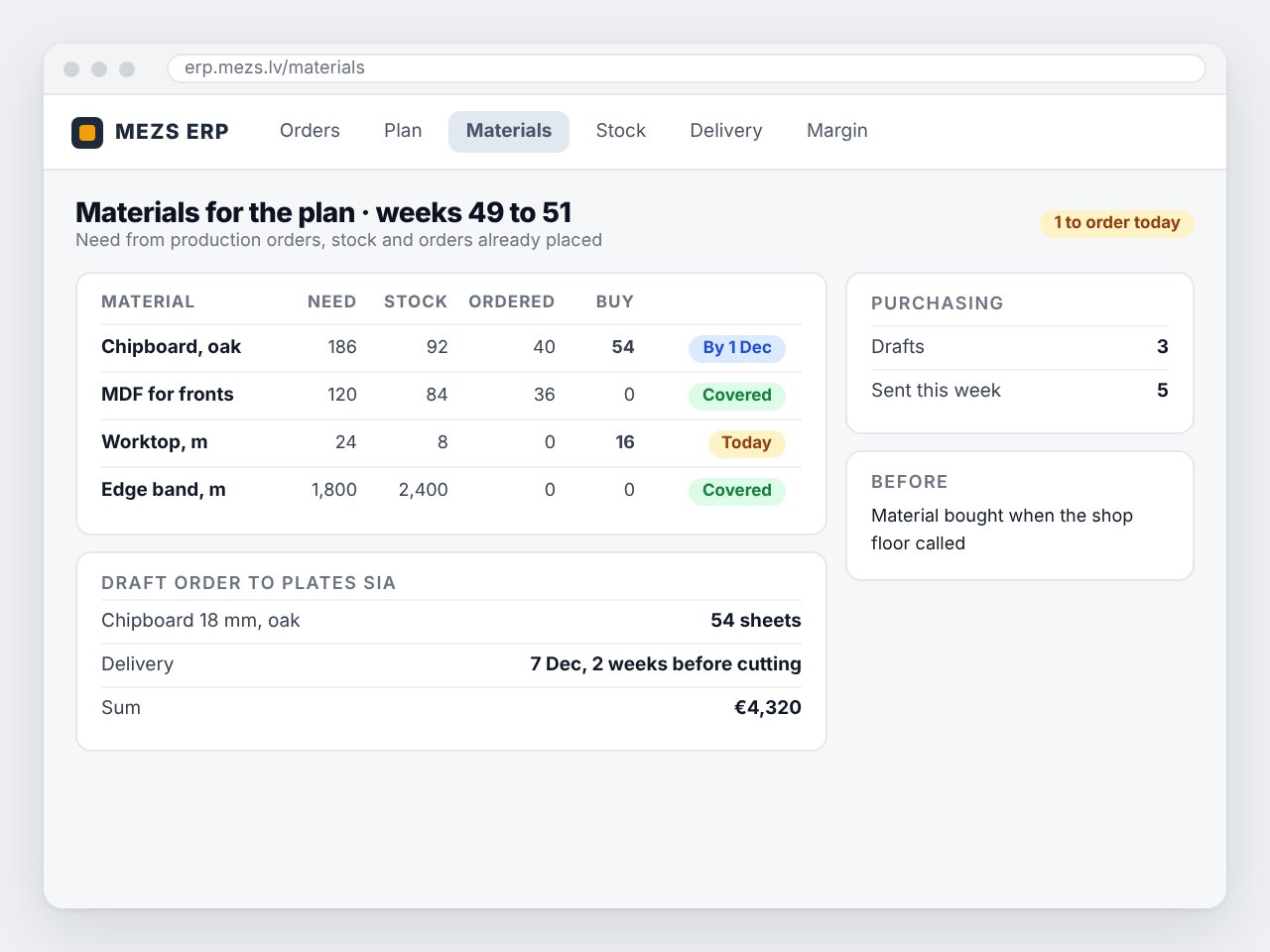
Materials for orders
The system calculates material requirements from the plan, compares them with stock levels and prepares purchase orders.
Example: Production no longer stops for lack of board material: the purchase order is sent two weeks before work begins.
Purchasing when the shop floor calls.
Purchasing to plan.
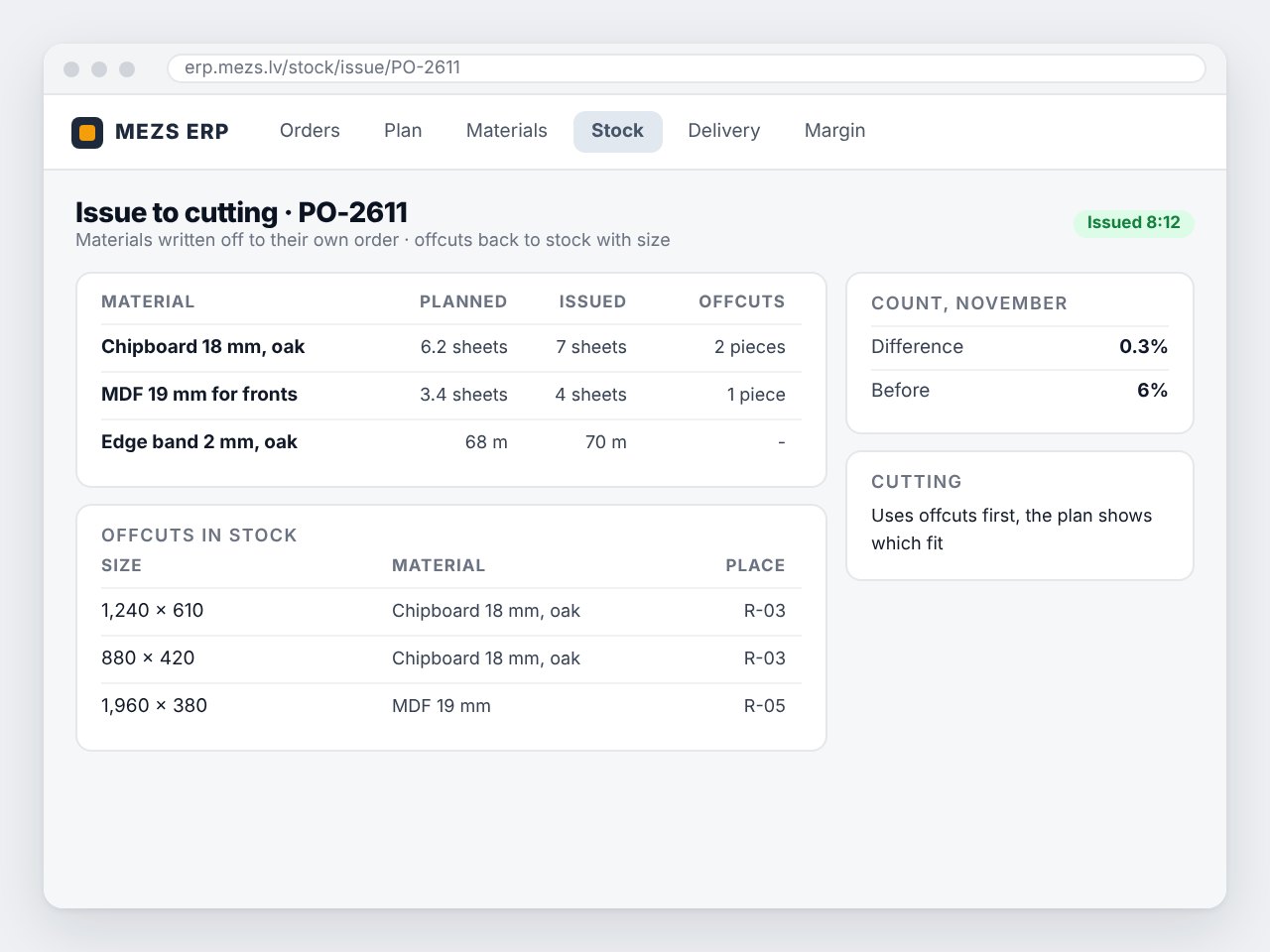
Warehouse and shop floor material issues
Materials inventory, issues to the shop floor against production orders, offcut tracking and receipt of finished goods.
Example: Every sheet of board is charged to its order, and stocktakes no longer show discrepancies between records and actual stock.
Materials charged in bulk.
Materials assigned to orders.
Dispatch and installation
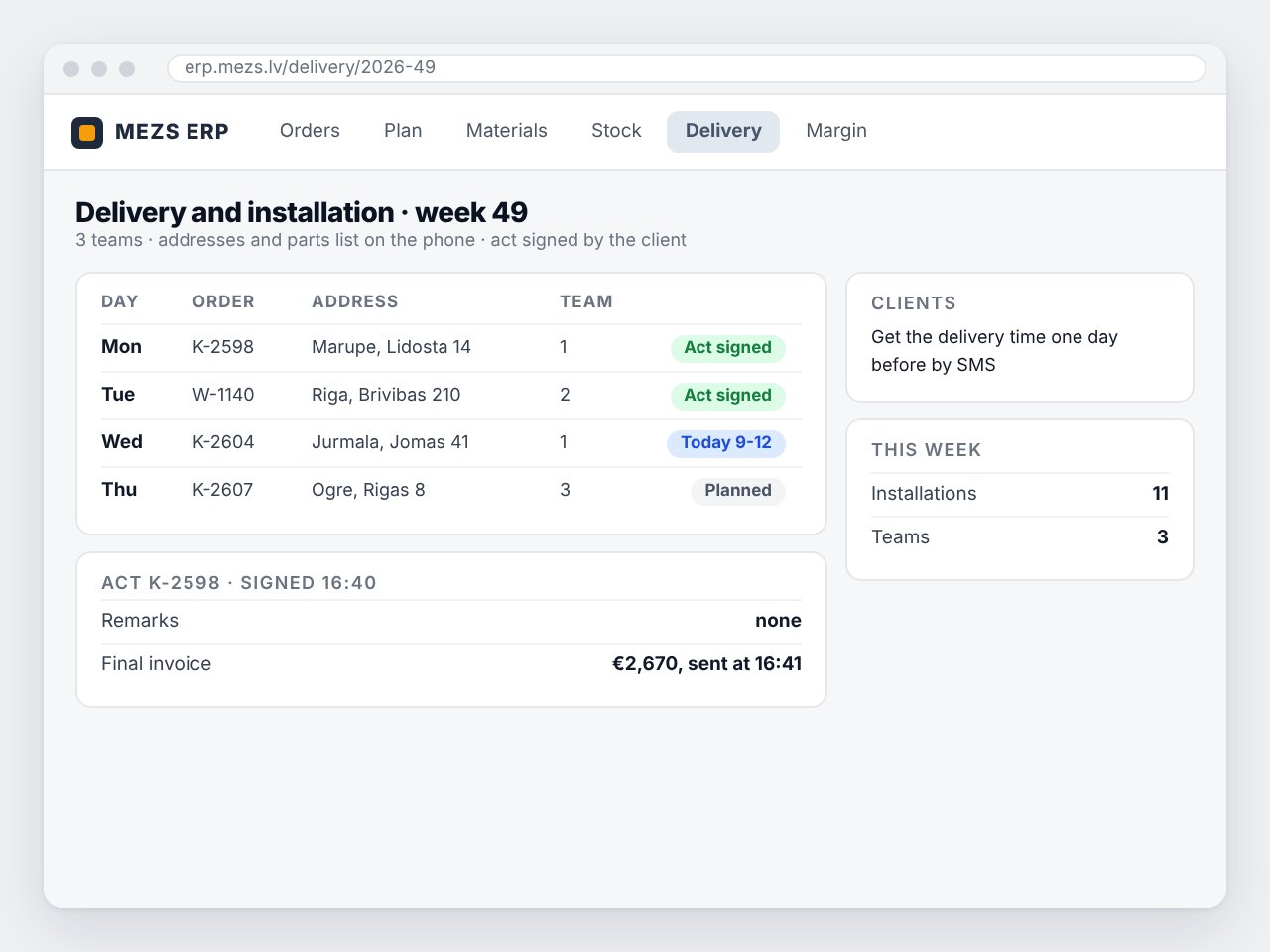
Completed orders are scheduled for delivery and installation, crews see addresses and order contents, and the customer signs the acceptance form on a phone.
Example: The customer receives the delivery time a day in advance, and the installation acceptance form goes straight into the system for final invoicing.
Paper acceptance forms.
Acceptance form in the system.
Cost and margin
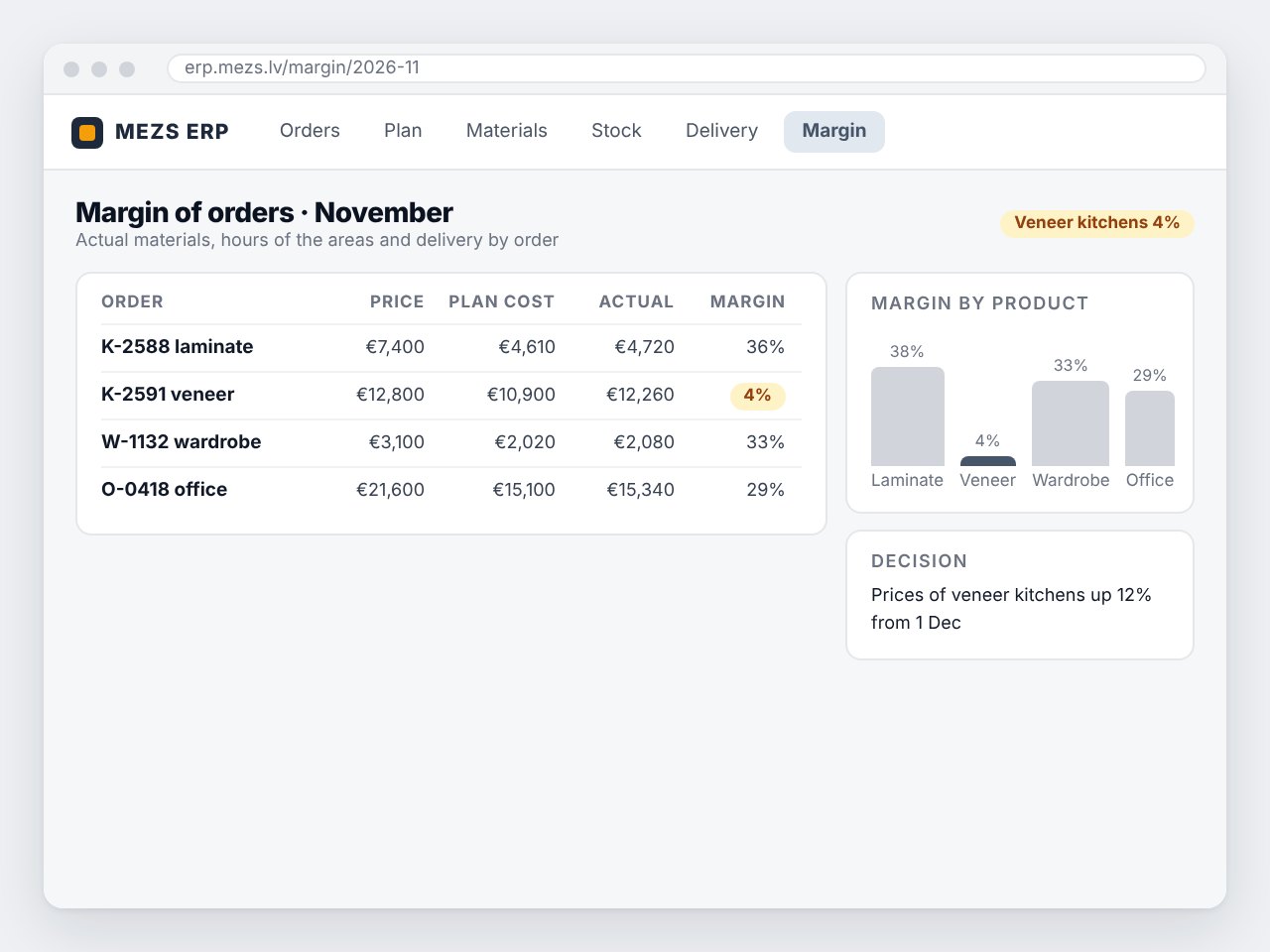
Actual materials, work area hours and delivery costs are recorded against each order, so managers see planned and actual costs and margins.
Example: The manager saw that veneered kitchens were selling with almost no margin and raised their price by 12%.
Margins after month-end.
Margin on every order.
What can AI add?
Quotes from sketches. AI reads a sketch or customer request and prepares a draft specification.
Deadline forecasts. AI warns of order delays based on shop floor workload and past performance.
Purchasing. AI suggests purchase quantities based on the season and supplier prices.
Questions in plain language. Managers ask about orders and margins in plain language and get an immediate answer.
How does the project work?
-
Brief and technical specificationWe review your requirements and prepare a brief. For projects starting at €5,000, we also prepare a technical specification, which sets the basis for the fixed price.Timeframeup to 5 daysTechnical specification: around 5 working daysWork starts within 3 working days of receiving the advance payment.
-
Development in stagesWe demonstrate each stage in a demo environment and submit it by email. You accept it by replying or paying the next invoice.Timeframe8-30 weeksbasic version 8-12 weeks, manufacturing ERP system 16-30 weeks
-
LaunchWe migrate products, specifications, stock balances and open orders, launch modules one at a time, and train sales managers, procurement staff, warehouse staff and shop floor supervisors. After full payment, you own the source code.Timeframearound a weekDeployment to hosting, launch and testing on the hosting server are included in the price.
-
Warranty and further development6 months of warranty and support free of charge. After that, you can opt for an extended warranty, which includes hosting.Timeframe6 monthsfree of chargeNew modules are added in stages.
How much does a manufacturing ERP system cost?
Basic version
-
Support
- Initial implementation support
- Basic documentation and training
- 6 months of post-launch support
-
Functionality
- Orders and specifications
- Production orders
- Materials inventory
- Procurement
- Department access permissions
-
Integrations
- Accounting software
-
Extended warranty
-
Included in the price: deployment to your hosting and launch. The first 6 months of warranty and support are free of charge.
-
ERP system for manufacturing
-
Support
- Introductory training and training sessions
- 6 months of support with the option of extended support
-
Functionality
- Everything in the basic version
- Planning and delivery dates based on workload
- Materials planning
- Shop floor material issues and offcuts
- Dispatch and installation
- Cost and margin
- Management reports
-
Integrations
- Accounting software
- Design software
- Banking
-
Extended warranty
-
From €300 per month: includes VPS hosting, priority support and fixes for critical and logic errors.
-
Large-scale ERP system
-
Support
- Introductory training and training sessions
- 6 months of support with the option of extended support
-
Functionality
- Everything in the manufacturing ERP system
- Multiple sites
- Shop floor terminals
- Equipment integration
-
Integrations
- CNC machines
- Any systems via API
-
Extended warranty
-
Priced according to project scope. Everything in the extended warranty (VPS hosting, priority support, fixes for critical and logic errors), plus full coverage: fixes for all types of errors and replacement of the provider or API if external integrations become unstable or outdated.
-
Shall we make a prototype?
With the most advanced AI solutions we build a clickable, interactive prototype of your system in one working day. With realistic test data, ready for presentations and further system design.
- Clickable main screens, made by AI
- A link to share with your team
- The scope of the first version
- A fixed price for the development
No obligation: you pay only for the prototype.
Similar projects:
Cryptocurrency company (anonymous)
Cryptocurrency exchange

Latvia
The client emphasized that the platform was vital to their operations and that they couldn’t function without it.
They appreciated 2410’s responsiveness, adaptability, and ability to deliver complex functionality - including fee logic, API integrations, and automation.
Communication was clear and proactive. The project evolved into a trusted long-term collaboration, with future expansions already discussed and initiated.
Riga Plaza
Shopping center
Latvia
Thank you!! Everything looks really great. You are incredibly fast! Huge thanks! Perfect! The client approved it. Please send the files.

Eliard SIA
Real estate
Latvia
Eliard praised the collaboration with 2410 for its adaptability, solution-oriented communication, and high-quality execution.
The project had complex requirements and tight deadlines, yet was handled efficiently. Additional feature requests were considered promptly, showing 2410’s flexibility and reliability in delivering tailored real estate platforms.


Who needs a manufacturing ERP system?
Furniture and kitchens
Metalworking
Food manufacturing
Windows and doors
Other ERP-based solutions
The same ERP system, configured for a different industry.
Fixed price and code ownership:
The project is divided into stages, each with a fixed price. We demonstrate each stage in a demo environment and submit it by email. You accept it by replying or paying the next invoice.
-
Handover. Source code repository and server access credentials.
-
Hosting. Migration is included in the price: to a DigitalOcean cloud server or your company's server.
-
Team. The 2410 team works remotely with clients from any country.
-
Contract and NDA. The contract is signed electronically. An NDA is available on request.